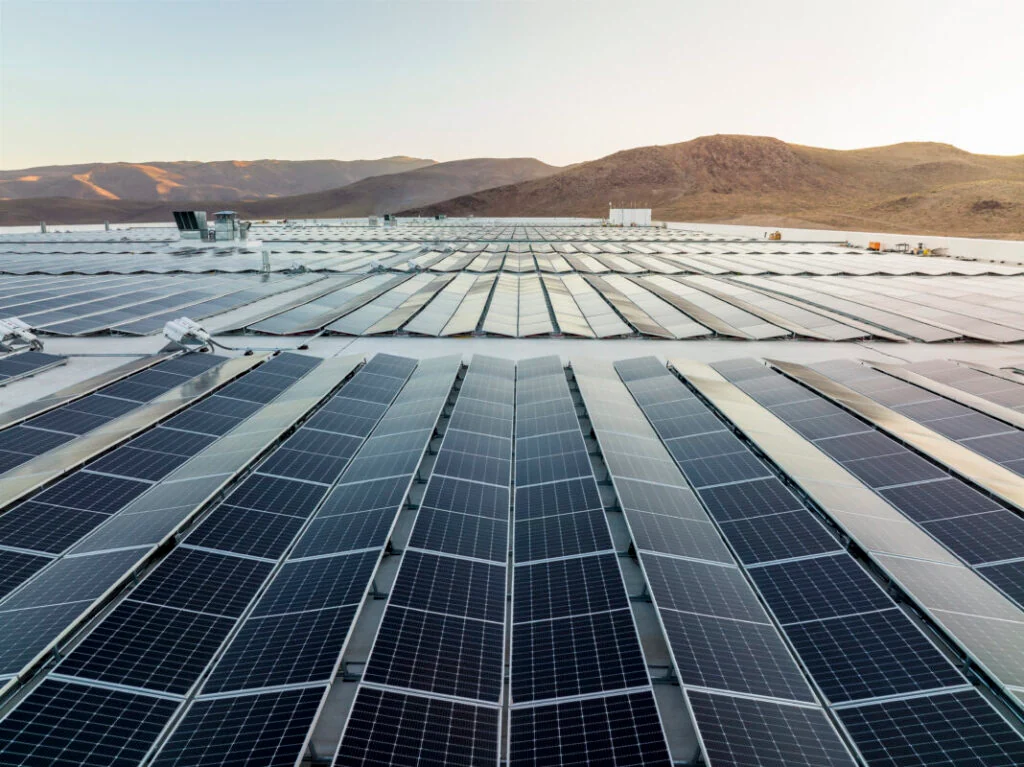
US solar manufacturing has become an increasingly important part of the future of clean energy in the US, especially as tariffs create uncertainty and supply chain bottlenecks abound. As industry interest continues to grow, companies are expanding domestic production and working to strengthen the nation’s energy infrastructure. Read more below about recent news coverage regarding solar manufacturing in the United States and the impact that this has on the energy sector.
US solar firms Heliene, Caelux launch tandem panel – Reuters
US solar energy manufacturers Heliene and Caelux said on Tuesday they had started commercial production of a new solar panel that stacks conventional silicon cells with a promising advanced material, generating more electricity in less space.
The companies’ tandem solar panel achieves an efficiency of 27%, they said in a statement, and is capable of producing about 20% more energy than conventional modules in the same space. “With both companies manufacturing in the US, we’re bringing together two fully domestic supply chains to advance what’s possible with American-made solar, besides the fact that partnering with true friends also makes it fun,” Heliene CEO Martine Pochtaruk said in a statement.
A brief history of US solar – pv magazine
The Solar Energy Industries Association (SEIA), launched 50 years ago, recently outlined the significant milestones in its Solar century: Landmark moments in the history of solar energy, beginning with the first silicon solar cells developed in 1954 in Bell Labs in New Jersey. Much research followed release of the prototype, and then in 1961, the United Nations held a “New Sources of Energy” conference to exchange ideas on the applications of solar, wind and other forms of alternative energy.
In the past 70 years, solar has become an integral part of the technologies feeding the U.S. grid. In just the past decade, solar’s share of U.S. electricity generation has grown seven-fold, and SEIA expects that solar will continue making up the bulk of new energy additions through and beyond 2060.
US Ends Solar Tariff Dodges, But Building Own Sector Is Tough – EnergyNow
Equipment made outside the US will be subject to minimum prices all along the supply chain, from pure polysilicon to wafers to cells to finished modules. There will also be an additional tariff. While that may be enough to put a stop to the catch-me-if-you-can game played by foreign suppliers, it remains to be seen whether it will be sufficient to help rebuild US solar manufacturing.
American energy policy has whipsawed over the past decade, with the current administration favoring fossil fuels, making it difficult for manufacturers to gauge future demand. Even if US firms do build solar plants, their products will almost certainly be more expensive and less advanced than those the rest of the world is receiving from Chinese companies.
Clean Investment Monitor: The State of US Clean Energy Supply Chains in 2026 – Rhodium Group
US clean energy manufacturing capacity has expanded notably since the spring of 2025, when Congress was debating whether to repeal key incentives enacted by the Inflation Reduction Act (IRA). As of Q3 2026, capacity for domestically produced battery modules, battery cells, and solar cells, as tracked by the Clean Investment Monitor (CIM), has roughly doubled from Q1 2025 levels. Domestic manufacturing capacity for solar modules, wind blades, and nacelles has expanded by roughly 50% from Q1 2025, reflecting new facilities that have come online. The growth occurred as long-term projected demand for those clean technologies was dragged down by policy changes, such as the repeal of federal greenhouse gas (GHG) emissions standards for vehicles, and regulatory headwinds, such as permitting constraints on renewable energy.
In this analysis, we assess the state of supply chains for solar, wind, batteries, and electric vehicles (EVs) as of Q3 2026 by comparing announced domestic manufacturing capacity from the CIM database with annual deployment of those technologies in 2025, and the range of projected annual deployment of those technologies from 2030 to 2035 as modeled in Rhodium Group’s Taking Stock 2026 report. We also summarize trends from our tracking of US clean energy manufacturing investment, updated through Q3 2026.
Inox Solar Americas moves 3 GW North Carolina cell factory into equipment installation – Energies Media
2026 has been a record-breaking year in the United States’ solar energy sector but there is a huge belief among industry experts that the nation will be able to break even more records in the coming year. The U.S. government has consistently been on the same page with private companies ever since the clean energy transition started which is a sign of the nation’s dedication to reaching its set objectives. Companies are aware of the position that the U.S. has as a solar energy powerhouse, and they are determined to play a part in ensuring that it maintains its respect. On that note, Inox Solar Americas moved 3 GW North Carolina cell factory into equipment installation.
The company will be hoping to carve out its own lane and have impact in the solar energy sector. Its approach reiterates qualified sourcing, documented manufacturing processes, and compliance readiness to assist customers to manage increasingly complex procurement and project demands.
U.S. solar manufacturers speak on executing profitability and scale as domestic capacity crosses 100 GW – pv magazine
Looking ahead, panelists debated whether a 100% self-sustaining domestic supply chain is realistic or even strategically sound. Colville argued that attempting to build every upstream material from scratch within a tight timeframe risks creating expensive, low-quality products that cannot compete globally. Instead, he advocates for identifying targeted domestic priorities while maintaining pragmatic trade relationships for specialized upstream materials. Highing the risk of forced isolationism, Colville warned against unrealistic expectations for complete self-reliance.
Ultimately, bridging the gap between ambitious manufacturing announcements and commercial execution will require a pragmatic balancing act. As the U.S. solar sector digests evolving trade policies, navigates impending Section 232 import guidelines, and scales up regional workforces, the ultimate measure of success will not be headline-grabbing capex figures, but long-term asset bankability and sustained manufacturing profitability.
First Solar inaugurates 1.7GW initial phase of South Carolina module manufacturing facility – pv tech
The inauguration marks the final production processes for its Series 6 Plus PV modules in the US. According to the firm, the Gaffney plant’s capacity is set to double to 3.4GW when the second phase is completed in mid-2027. The facility uses thin-film cells produced at the company’s overseas sites to complete the final manufacturing stages of its Series 6 Plus modules.
First Solar announced plans for the Gaffney facility in late 2025 as part of its expansion of US manufacturing operations. Once fully commissioned, the site will bring the company’s total US nameplate manufacturing capacity to approximately 17.7GW. First Solar said it expects to have invested more than US$5 billion in US manufacturing and research and development (R&D) infrastructure by the end of 2026.
SEG Solar secures land for new Texas manufacturing facility – Solar Builder
In May, SEG announced a new module production plant in the Houston area, creating 800 jobs for Harris County and nearly 500,000 square feet of manufacturing space to SEG’s ranks. In total, the Houstonian firm has announced three new module production facilities near the U.S.’s fourth-largest city, bringing its American manufacturing capacity to 10.6 GW.
The most recently announced plant will include manufacturing, warehousing, a research and development center, a testing laboratory, and planned EVA and junction box production. The company says the new HJT modules will provide a dependable, domestic source of U.S.-manufactured solar supply, which is “something increasingly valuable in today’s market.”
The wins and weak spots in America’s solar supply chain – Canary Media
Factories in the U.S. can produce more than enough finished solar panels — also known as modules — to supply the nation’s annual installations, which last year hit 47.9 gigawatts (measured in direct current capacity). Module production could grow by about 83% if all the projects that have been announced or are going through construction and commissioning come to fruition. The expansion represents a major change of fortune for domestic solar manufacturing, which had nearly disappeared, but has blossomed in recent years thanks to federal incentives and stiffer tariffs against foreign products.
Still, the panel is just the final step in the solar supply chain. To truly onshore this critical industry, the U.S. also needs to make the components that go into the module: photovoltaic cells, which are etched onto silicon wafers, which are made from processed polysilicon.
First Solar Shares Surge 8.1% as Democratic Midterm Victory Boosts Renewable Energy Stocks – Yahoo Finance
The Democratic Party’s victory in both the House of Representatives and Senate prompted investors to reassess the outlook for renewable energy companies. Market participants anticipate that Democratic control of Congress could create a more supportive legislative environment for clean energy investment and domestic solar manufacturing.
Broad gains across the solar industry, including advances of as much as 12% for Enphase Energy and SolarEdge Technologies, reinforced the positive sector reaction. Investors will now be monitoring potential developments in federal renewable energy policy, the outlook for domestic manufacturing incentives and First Solar’s ability to maintain favourable pricing conditions.
Tesla considers Fort Bend for $10 billion solar manufacturing site – Spectrum Local News
Tesla is considering a potential $10 billion deal that could bring nearly 10,000 jobs and thousands of dollars in revenue to Fort Bend County. It involves the construction of what officials call the largest single solar cell manufacturing site in the country.
The Lamar Consolidated Independent School District approved tax incentives for Tesla in September. Supporters say the plant would provide job opportunities for local students and residents. However, there’s no guarantee Tesla will build the plant at the proposed location at FM 1994 and FM 762 near Needville in Fort Bend County. The company says the county is competing with another location outside of Texas.
Conclusion
Solar manufacturing is a fast-rising industry with numerous facilities in different stages of development. For a solar manufacturing to succeed, the full lifecycle must be accounted for, spanning job training, safety, procurement of critical materials, incorporation of global products, and finally – meeting demand.
FischTank PR is a leading PR firm with solar manufacturing PR knowledge that focuses on messaging around solar manufacturing projects. If you’re looking to make your brand stand out, contact [email protected].
***News roundup guest post from FischTank PR interns Pat Hwang and Allison Gavagan***