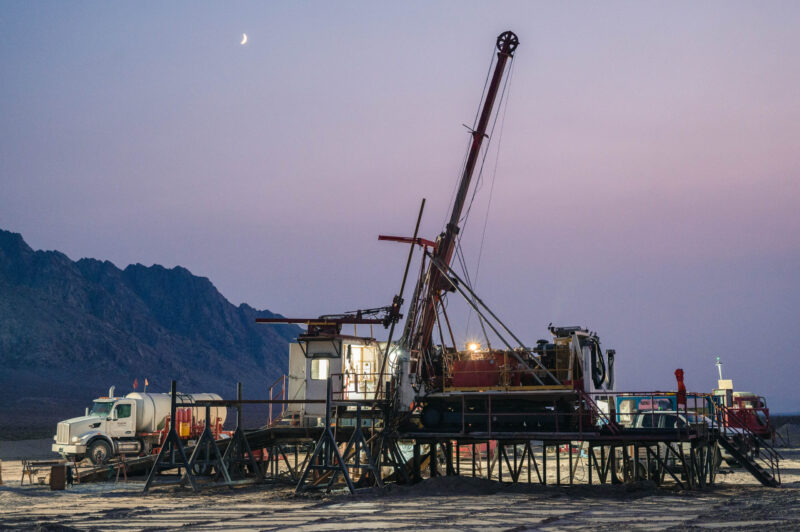
Geothermal energy is an underutilized yet reliable, clean and capable resource coming to the forefront as they gain renewed attention. Unlike wind and solar, geothermal has the ability to provide “aways on” power, meaning they can produce energy regardless of weather or time of day. This makes them a key contender in the race for clean electricity. Whether it’s local heating needs or massive data centers, the expanding role of geothermal energy offers both environmental and economic benefits, highlighting how the technology has been overlooked for too long. Read more below about the impact of geothermal projects as they continue to scale.
How AI is uncovering hidden geothermal energy resources – MIT Technology Review
A startup company called Zanskar announced today that it’s used AI and other advanced computational methods to uncover a blind geothermal system—meaning there aren’t signs of it on the surface—in the western Nevada desert. The company says it’s the first blind system that’s been identified and confirmed to be a commercial prospect in over 30 years.
Zanskar’s approach is more precise. With advancements in AI, the company aims to “solve this problem that had been unsolvable for decades, and go and finally find those resources and prove that they’re way bigger than previously thought,” says Carl Hoiland, the company’s cofounder and CEO.
Disclaimer: Zanskar is a FischTank PR client
Fervo Energy Raises $462 Million, Lands Google as Investor – WSJ
The geothermal company Fervo Energy has privately raised $462 million from investors including Google to continue to develop a major project in Utah and fund new developments, company officials said.
Houston-based Fervo uses technology pioneered by oil-and-gas drillers to frack rocks, create geothermal reservoirs and crank out electricity. The company is spending more than $2 billion in Utah to build what it expects to be the world’s largest enhanced geothermal project. It has said it can help sate power-hungry data centers, electric vehicles and growing industries.
Geothermal is a perfect match for data centers because geothermal projects need to run 24/7 to operate optimally, according to Roland Horne, the director of Stanford University’s geothermal program.
Geothermal is seeing tailwinds in Washington, D.C., where it is one of the few renewable sources of energy that has the favor of the Trump administration. Following a reorganization, the Energy Department recently created the Hydrocarbons and Geothermal Energy Office.
How geothermal energy could provide ‘always on’ supply – Financial Times
Geothermal energy supplies less than 0.5 per cent of global demand — mostly for heating rather than electricity, and usually in parts of the world with volcanic or seismic activity. But interest is growing in fracking techniques pioneered by the oil and gas industry that could make geothermal energy more widely available.
Geothermal power is obtained by drilling wells, usually 1-3km deep for large schemes or 30-200 metres for smaller neighbourhood ground source heating schemes, in suitable parts of the world. These are usually regions with volcanic activity or near the boundaries of tectonic plates — such as Iceland, the US and the Philippines — which mean the earth’s heat is closer to the surface.
The major attraction of geothermal energy is that it is constant and stable — unlike wind and solar power, which are weather dependent.
Geothermal could meet 64% of hyperscale data center power demand – Latitude Media
Enhanced geothermal would be particularly effective in the West, according to the report. Of all major markets in the United States, only Atlanta and New York City aren’t conducive to behind-the-meter geothermal.
But geothermal energy holds even more promise if developers decide where to put their data centers based on energy access rather than fiber access — an approach that Google seemed to take in its new partnership with Intersect Power and TPG Rise Climate. If hyperscalers build data centers “wherever they have access to the most affordable geothermal energy,” the report found that “geothermal could easily meet all projected data center load growth in the early 2030s.”
How Geothermal Energy Delivers Six Strong Benefits for the Future – Energy, Oil & Gas Magazine
As the global demand for sustainable power accelerates, geothermal energy is gaining recognition as a reliable, clean, and economically sound solution. By harnessing thermal energy from deep within the Earth, geothermal systems provide electricity and heating in a consistent and efficient manner.
The advantages of geothermal energy are compelling. It offers a rare combination of sustainability, reliability, and economic efficiency. As global energy systems transition away from carbon-intensive fuels, geothermal energy is poised to become a foundational technology.
With its ability to deliver base load power, reduce emissions, and support economic resilience, geothermal energy deserves a prominent role in national and global energy policies. As investments and innovations continue, thermal energy from beneath the Earth’s surface could unlock a cleaner, more stable future.
Why the Time Has Finally Come for Geothermal Energy – The New Yorker
In some ways, the process of harnessing geothermal energy is simple. The deeper you dig, the hotter the temperatures get. For direct heating, you dig relatively shallow wells (typically several hundred metres deep), to access natural reservoirs of hot water or steam, which can be piped into a structure. For electricity, wells are dug farther down, to where temperatures are above a hundred and fifty degrees Celsius. (In Iceland, this temperature is reached at around one thousand to two thousand metres deep.) Pressurized steam spins a turbine that in turn spins a generator. Thermal energy (steam) is translated into mechanical energy (the spinning turbine), which is translated into electrical energy (via the generator). Geothermal energy is essentially carbon-free, it is available at any time of day and in any weather, and it leaves a small—albeit very deep—footprint on the landscape.
Officials greenlight $7 million project to tap into powerful underground energy source: ‘We are seeing growing interest’ – The Cool Down
The Colorado Energy Office awarded $7.3 million to four geothermal heating and cooling projects in Denver, Colorado Springs, Vail, and Steamboat Springs, according to Colorado Biz. The funding comes from the Colorado Geothermal Energy Tax Credit Offering, which will go towards three installations and a feasibility study.
Geothermal energy is heat energy that comes from the earth, usually from reservoirs of hot water, according to the Department of Energy. The heat can be used to generate energy or for heating and cooling by using the earth for either heat storage to cool temperatures or a heat source for warmth.
There are a lot of benefits to geothermal technology, first and foremost being that it’s renewable and sustainable. It’s a clean energy source, so there’s no planet-warming gases coming from geothermal energy plants, which also have a smaller footprint than a traditional fossil fuel power plant. That translates into better air quality.
Is geothermal energy ready to make its mark in the US power mix? – McKinsey & Company
Conventional geothermal energy is a long-established clean, firm power source, but it has not achieved scale in the United States because it relies on naturally occurring underground structures that exist only in some parts of the country. Two factors are now coming together to create a new opportunity horizon for geothermal: rapidly rising demand for clean, firm power and next-generation subsurface technology breakthroughs. Next-generation geothermal energy approaches can be deployed in many more locations, and thanks to recent technological advances, they are on a trajectory to become cost-competitive soon.
Do the Advantages of Geothermal Energy Justify Greater Federal Support? – Resources
The heat in the rocks several miles below the surface of the Earth, known as geothermal energy, could meet global energy demand for hundreds of years. The International Energy Agency estimated in 2024 that, with adequate increases in support, the costs associated with next-generation geothermal energy could fall 80 percent by 2035 to about $50 per megawatt-hour. This decrease would make geothermal highly competitive with electricity from solar and wind energy when both wind and solar are paired with battery storage. The development of geothermal energy will likely benefit from technologies and processes honed by the oil and gas industry, as well.
Is the U.S. Headed for a Geothermal Energy Comeback? – Triple Pundit
Geothermal energy is far behind wind and solar for renewable power generation in the United States. Wind accounted for just over 10 percent of the nation’s electricity mix in 2023, and solar turned in 3.9 percent, according to the U.S. Energy Information Administration. In contrast, geothermal energy only reached the 0.4 percent mark of total U.S. power.
But geothermal energy has a crucial advantage over wind and solar. Since it’s sourced from heat inside the Earth, geothermal energy is available without interruption on a 24/7 basis, regardless of the weather and seasonal changes. And, just as the wind and solar industries benefited from innovation and cost-cutting since the early 2000s, geothermal energy is in the midst of a technology transformation.
New geothermal developments cover three areas: centralized power plants for the electricity grid, heating plants for whole communities, and individual geothermal heat pumps for homes and buildings.
All of these systems are based on drilling into the ground to capture heat generated by the Earth’s core. Geothermal power plants convert that heat into electricity, while heating plants and heat pumps use it to heat and cool homes, buildings, and even whole neighborhoods. Tapping new sites with advanced well-drilling systems could increase the use of geothermal energy twentyfold by 2050, according to a 2024 report from the U.S. Department of Energy. Beyond generating power, heat pumps and heating plants could heat and cool up to 80 million homes by midcentury, the agency estimates.
Geothermal energy has huge potential to generate clean power – including from used oil and gas wells – The Conversation
The promise of new engineering techniques for geothermal energy – heat from the Earth itself – has attracted rising levels of investment to this reliable, low-emission power source that can provide continuous electricity almost anywhere on the planet. That includes ways to harness geothermal energy from idle or abandoned oil and gas wells. In the first quarter of 2025, North American geothermal installations attracted US$1.7 billion in public funding – compared with $2 billion for all of 2024, which itself was a significant increase from previous years, according to an industry analysis from consulting firm Wood Mackenzie.
A May 2025 assessment by the U.S. Geological Survey found that geothermal sources just in the Great Basin, a region that encompasses Nevada and parts of neighboring states, have the potential to meet as much as 10% of the electricity demand of the whole nation – and even more as technology to harness geothermal energy advances. And the International Energy Agency estimates that by 2050, geothermal energy could provide as much as 15% of the world’s electricity needs.
Geothermal is capable of providing significant quantities of energy. For instance, Fervo Energy’s Cape Station project in Utah is reportedly on track to deliver 100 megawatts of baseload, carbon-free geothermal power by 2026. That’s less than the amount of power generated by the average coal plant in the U.S., but more than the average natural gas plant produces.
Geothermal energy looks set to go from niche to necessary – The Economist
Apart from in hot zones like Iceland and New Zealand, conventional geothermal power has largely been limited to the few places where intense heat, pressure and water are found close enough to the surface to be tapped by conventional drilling techniques. These limitations explain why, over a century since its first use to make power, in Italy, geothermal provides less than 1% of global electricity.
Pioneers of “enhanced geothermal” techniques believe they can apply innovations from the shale industry, such as fracking and multilateral drilling, to enable geothermal almost anywhere. At the forefront is Fervo. The firm proved that its technology works at a pilot plant in Nevada. Now it has scaled up operations dramatically at the Utah site and, in doing so, shown a 70% reduction in drilling time year on year (see chart) while achieving high temperatures and flow rates. In 2026 it will start to deliver energy to the grid. Fervo is contracted to supply 320 megawatts of power to Southern California Edison, a utility, in the largest-ever commercial contract for geothermal power.
A Startup Says It Has Found a Hidden Source of Geothermal Energy – WIRED
A geothermal startup said Thursday that it has hit gold in Nevada—metaphorically speaking. Zanskar, which uses AI to find hidden geothermal resources deep underground, says that it has identified a new commercially viable site for a potential power plant. The discovery, the company claims, is the first of its kind made by the industry in decades.
But a big part of the geothermal puzzle is actually finding these resources. It’s rare to find hot springs or vents at the surface that lead to a productive spot to put a power plant. Most geothermal systems that are hot enough to make electricity are deep underground, and there is no evidence at the surface. These are known as hidden or blind systems—and identifying where they are is surprisingly challenging. As a result, many geothermal power plants are built over systems that were found accidentally, while drilling for agricultural wells, minerals, or oil and gas exploration.
“It is sort of a needle-and-haystack problem,” says Joel Edwards, Zanskar’s other cofounder. “A very small percentage of the land that you will look at will have a geothermal system associated with it.”
Disclaimer: Zanskar is a FischTank PR client
Is geothermal energy poised to become the next big source in the clean energy mix?
New drilling techniques, capital investment and early commercial projects are pushing geothermal from experimental to viable. As this young sector matures, companies across energy, tech and infrastructure have a rare opportunity to shape the narrative and the market while it’s still taking form. At FischTank PR, our geothermal energy PR, media relations and communications strategies help to secure great coverage for brands that enable them to stand out and connect with the right audience.
If you’re interested in achieving exposure for your energy brand, reach out to us at [email protected].
***News roundup guest post from FischTank PR interns Abby Collins and Nana Duah***