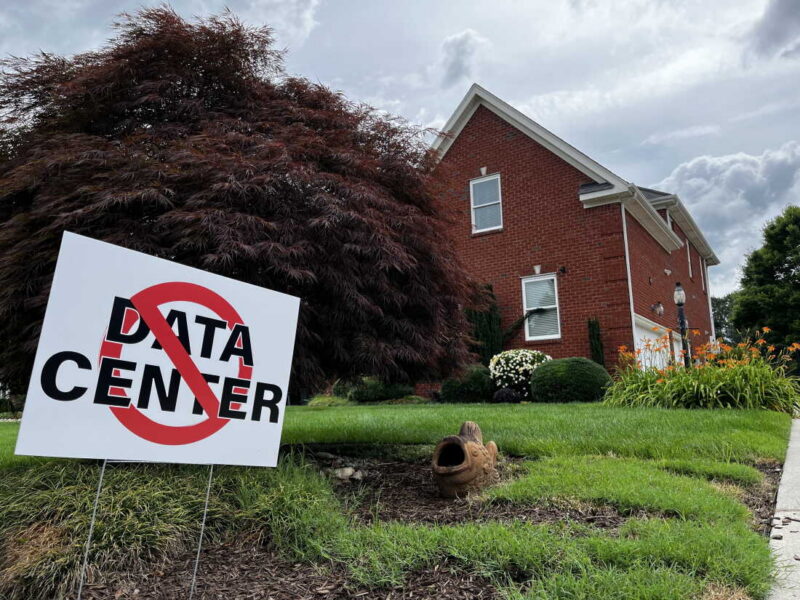
As data centers continue to pop up across the U.S., concerns from homeowners and businesses alike are having direct impacts on the future of AI. Local data center opposition continues to affect policies, construction timelines and future plans for data center companies. Read more below about recent news coverage regarding the strong opposition to local data centers and the impact that this has on data centers across the United States.
The Great Data-Center Rebellion – The Atlantic
According to a recent NBC poll, nearly 70 percent of Americans oppose the construction of a data center in their area. Kevin Bradley of Clintonians Against Data Centers observed that this many Americans haven’t agreed on anything since 9/11: “This is affecting all of us—rich, middle-class, and poor. We’re coming together because we’re not happy.” More than 500 jurisdictions have passed moratoriums or bans. This grassroots movement rose so fast and spread so widely that politicians in both parties, including Iowa’s candidates for governor and senator, are struggling to catch up with their constituents. The meteoric emergence of the data-center rebellion is a response to the speed and scale of construction, which in turn reflect the sudden ubiquity of generative and agentic AI.
But the facts about water consumption and tax revenues, though important, are not the crux of the matter. Opposition to data centers comes from a deeper concern than NIMBYism, resource misuse, or environmental harm. Over and over, Clintonians expressed a feeling of being misled, ignored, disrespected, betrayed—of having no say over basic matters in their own lives. The data center seemed to be a deal made among secretive insiders—huge, far-off entities in Silicon Valley, on Wall Street, and in Washington, as well as the local leaders of their own city. To the tech giants, QTS, Blackstone, and the Trump administration’s AI boosters, Clinton is an empty space on the Mississippi that looks like an opportunity. That the industry seeking to buy 1,100 acres on the west side of town is in the business of replacing human beings with machines—and perhaps, according to some AI experts, even rendering them extinct—only intensifies a sense of powerlessness.
Outmaneuvered, outmatched and outspent: How data centers are overwhelming small-town America – Oregon Live
“We were read the facts of what could happen. This township does not have the money to fight these big companies,” Marion said. “We were dealt the cards we were dealt, and we felt our hands were tied.”
Similar battles have played out in various ways across the country as data centers have proliferated and artificial intelligence has boomed. Because data centers need lots of land and electricity, and the new hyperscale AI data centers need much more of each, they often target rural communities. Local officials are often overwhelmed and outmatched. \
Data centers are changing America’s landscape, report says – CBS News
Grassroots efforts to block data center development have thwarted some planned projects. In the second quarter of 2026, advocacy groups disrupted at least 45 developments across 27 states, valued at $68 billion, according to a report shared with CBS News by Data Center Watch, which tracks public opposition to the facilities.
“Organized opposition became more geographically widespread and visible online, with petition activity expanding significantly and campaigns increasingly addressing statewide policy, utility regulation, and infrastructure,” the group said in its report.
Local Michigan officials wary of data centers, University of Michigan survey finds – The Michigan Independent
“Data centers are essential infrastructure; however, they should be distributed, community-integrated, and designed for resilience, workforce development, and local benefit,” one local leader said, according to the report. “Large, centralized facilities aren’t automatically bad; however, if they don’t strengthen local capacity, equity, and stewardship, they’re the wrong model – especially for rural regions.”
Without a statewide pause in place, dozens of local governments throughout Michigan have passed or proposed their own temporary moratoriums on data center development to give them time to review local zoning codes. The local moratoriums have ranged from four months to two years. At least two Michigan cities that have paused data center construction — Wixom in Oakland County and Gibraltar in Wayne County — have been sued by developers that claim the moratoriums are unlawful.
“US could be writing its own losing ticket”: Amazon warns against 100+ AI data center bans as it pledges $1 billion to defuse AI backlash – techradar
Residents and lawmakers increasingly question electricity demand, water consumption, environmental effects and the benefits delivered by large computing facilities. “If these measures are enacted, the U.S. could be writing its own losing ticket to this race, and the consequences would last generations,” said Matt Garman, Amazon Web Services (AWS) CEO. The concern for Amazon is that local restrictions could slow the expansion of computing infrastructure needed to support the country’s AI ambitions.
The program is offering more than $1 billion over five years to communities where its data centers operate. The initiative will support community college education, workforce preparation, energy improvements and grants for projects chosen with local input. Amazon expects the education funding to reach more than 300,000 students over five years by covering college costs not met through existing financial assistance.
Elizabeth Township commissioners, residents respond to data center report – The MonValley Independent
The development, located at a 549-acre parcel on Henderson Road near the Youghiogheny River, would include anywhere from 11 to 28 two-story data center buildings powered by a combined cycle generator. The site could generate $125 million in tax revenue for the municipality and Elizabeth Forward School District. The site is currently owned by Buena Vista Solar, which purchased the “Fiore Property” in 2022 for $1. A former U.S. Steel landfill site, it was once considered as a potential location for a now-canceled power plant.
Communities around the Mon Valley are taking action, with many local governments passing moratoriums to pause any data center development, giving local officials time to review and strengthen their ordinances before any future data center proposal can move forward. Allegheny County Council unanimously voted to ban large data centers on county-owned property last month as municipalities contemplate or implement data center construction moratoriums.
Data centers emerge as flashpoint in 2026 races as opposition rises – The National News Desk
At public meetings and protests, local officials are increasingly hearing sharp objections from residents concerned about the impact of data centers on water supplies, electricity costs and nearby communities. “We do not want a data center in this county! Do you understand?!” one resident angrily proclaimed during a July meeting in Franklin County, Virginia.
While data centers were once primarily sought for their potential economic benefits, Levendusky said much of the recent messaging has focused on environmental and energy concerns, as well as public distrust of — or unfamiliarity with — artificial intelligence. He suspects that major technology companies will mount a more aggressive counter-message.
How revelations like $450M tax breaks created a powerful opposition movement against Oregon data centers – Street Roots
Her draft bill prohibited data centers in the 1,700 acres “except as an accessory to” a large employer’s operation, and she told The Oregonian it wasn’t intended to open the door for more data centers on the land. Less than a week into the 2026 legislative session, however, she removed the data center tax-break increases from the bill after facing intense pushback. But it had already sparked a movement.
Diaz said the coalition’s lawsuit isn’t about whether the data centers can build — they can as long as they comply with all local rules — but instead attempts to redirect the money the city wants to give them to fund things that create more jobs and get the state more benefits back, like high-speed rail.
Virginia Takes Aim at Data Center Development, Energy Use – Government Technology
Gov. Abigail Spanberger on Friday announced the Data Center Accountability Framework and signed Executive Order 22 to address those concerns and set new rules for how the state handles data center development. Aspects of the framework not covered in EO22 and by agency directives must still be approved by the General Assembly. Specifically, the framework would change how data centers are approved and how communities are involved in those decisions, while also addressing who pays for the electricity and infrastructure they need, how they affect the environment and how they create opportunities for Virginia workers.
EO22 immediately prohibits executive branch agencies, boards, commissions, authorities and employees under the governor’s supervision from entering into or requiring non-disclosure agreements for data center projects. The order also directs the creation of a Data Center Planning and Community Engagement Toolkit for local governments and communities.
Conclusion
One of the biggest obstacles for data centers is local opposition. It’s important for businesses to understand local concerns and the need for transparency. FischTank PR is a leading climate and energy PR firm with deep data center PR knowledge that focuses on messaging around data center construction. If you’re looking to make your brand stand out, contact [email protected].
***News roundup guest post from FischTank PR interns Pat Hwang and Allison Gavagan***